
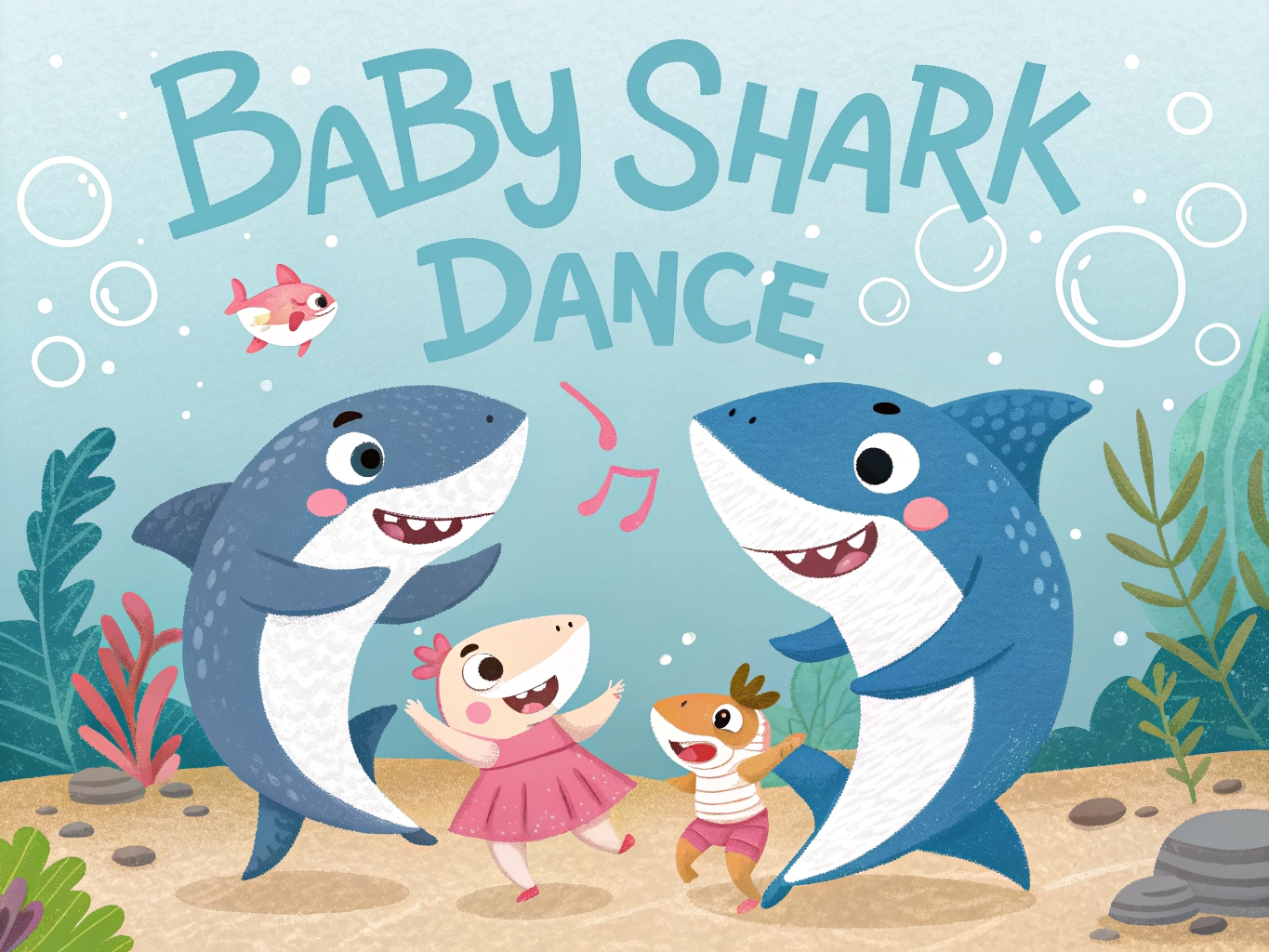
Every day, more than 122 million people open YouTube. Billions of videos compete for attention, but one has stood at the top of every ranking since 2020. With over 16 billion views by the end of April 2026, the most-watched YouTube video of all time is not the music video of a global pop star, nor a track by a multi-platinum rapper. It is a children’s nursery rhyme lasting less than two minutes, produced by a South Korean company that nobody had heard of. Here is the full story behind a record that keeps growing every single day.
The most-watched YouTube video in the world: Baby Shark Dance
Channel: Pinkfong Baby Shark – Kids’ Songs & Stories
Upload date: June 17, 2016
View count: over 16 billion (end of April 2026)
Likes: approximately 45–46 million
Duration: 2 minutes 16 seconds
Baby Shark Dance is an animated nursery rhyme featuring a family of sharks — baby shark, mommy shark, daddy shark, grandma and grandpa shark — accompanied by a minimalist dance routine that any two-year-old can replicate. Five notes, a steadily quickening tempo, bright colours, and endless repetition. The formula is disarmingly simple, and that is precisely why it works on a scale no one could have anticipated.
Where does Baby Shark come from?
The Baby Shark nursery rhyme is far from new. It has been circulating in American summer camps since the early twentieth century, passed down from generation to generation as a campfire song. In January 2013, a dark electro version by Malicia Darkwave turned it into a curious internet phenomenon, though without breaking through to a mainstream audience. A first Korean version published by Pinkfong on November 25, 2015 under the title 상어 가족 (“Shark Family”) laid the groundwork, before the English-language dance version was uploaded on June 17, 2016.
Pinkfong is a South Korean educational entertainment brand specializing in content for children. At the time, their YouTube channel was far from unknown, yet no one on the team could have anticipated that this particular video would become the single most massive cultural phenomenon in the history of the platform.
How Baby Shark went viral
The video initially remained a regional success. It exploded across Southeast Asia in 2017–2018, particularly in Indonesia and the Philippines, driven by word of mouth among parents and widespread sharing on local social media. It was not until 2018 that the phenomenon crossed oceans and flooded Western news feeds, fueled by the #BabySharkChallenge: millions of people posted their own videos dancing to the song, creating a self-reinforcing viral loop.
In 2019, the song entered the US Billboard Hot 100 — a complete anomaly for a children’s nursery rhyme. Its creators, who had designed the video with the intention of combining fun and learning, suddenly found themselves managing a global empire. More than 100,000 creator videos were produced using Baby Shark Dance as a base, generating additional revenue through YouTube’s Content ID system.
Baby Shark’s records, one by one
In November 2020, Baby Shark Dance surpassed Despacito by Luis Fonsi and Daddy Yankee to claim the top spot as the most-viewed video in YouTube history. At the time, it had accumulated approximately 7.5 billion views. What followed is nothing short of staggering.
On January 13, 2022, Baby Shark Dance became the first video in YouTube history to cross 10 billion views — a milestone the platform’s counter had not even been programmed to display when Gangnam Style reached one billion back in 2012. By June 2025, the video had surpassed 16 billion views. At the end of April 2026, it continued to grow at a rate of 100 to 200 million additional views per month, widening its lead each day over the second most-viewed video, Despacito, which remains stalled at 8.95 billion.
In other words: Baby Shark has nearly double the views of the video ranked just below it.
Learn more about YouTube monetization.
Why is this record impossible to beat?
Baby Shark’s dominance can be explained by a viewing pattern that no traditional music video can replicate: children watch the same videos on repeat, dozens of times a day, for months or even years. While an adult might watch a music video once or twice before moving on, an 18-month-old can ask for Baby Shark twenty times in a single day. Multiply that by hundreds of millions of children around the world, over ten years, and you get 16 billion views.
This is also why YouTube’s most-viewed videos are now dominated by children’s content: nursery rhymes, educational cartoons, interactive songs. CoComelon has several videos in the global top 10. Mainstream music videos, even the biggest worldwide hits, typically peak between 1 and 3 billion views over their lifetime. They simply cannot compete with the repeat-viewing behaviour that characterises young audiences.
Baby Shark: far more than just a video
What Pinkfong has built around Baby Shark extends far beyond a simple viral video. Today there is a television series, Baby Shark’s Big Show, toy ranges distributed worldwide, touring live shows, and merchandise spanning every imaginable category. Baby Shark has become a multi-billion-dollar commercial empire, built from a two-minute video uploaded by a team of educational content creators.
The Pinkfong channel now has more than 75 million subscribers on YouTube. In 2026, to mark the tenth anniversary of Baby Shark Dance’s upload, YouTube published an official blog post celebrating the video as a “shared cultural moment” that had brought parents and children closer together across the world.
What is the most-viewed YouTube video in France?
In France, the ranking of the most-watched videos of all time broadly follows the global trend, with Baby Shark Dance and Despacito leading the way. When it comes to the most-viewed French or French-language videos, however, the landscape looks different: creators such as Squeezie, Tibo InShape, and Inoxtag regularly generate tens of millions of views per video, yet none of them come close to the all-time global records — which is understandable, since those records are built on a worldwide audience accumulated over several years.
Why does YouTube remain the benchmark platform for view-count records?
With over 2.7 billion monthly active users, YouTube is the second most visited website in the world after Google. It is the only video platform where content uploaded ten years ago continues to accumulate views on a daily basis, without an algorithm burying it after 48 hours. This is what makes YouTube records fundamentally different from those on TikTok or Instagram: a YouTube video can age and keep on performing. Baby Shark is the ultimate example — uploaded in 2016, it still generates between 100 and 200 million views per month a decade later.
Find out more: https://agencemidnight.fr/restaurants-youtubeur-top-des-meilleurs-etablissements-2026/
How does a video become the most watched on YouTube?
The factors that send view counts through the roof
Several elements combine to propel a video towards record-breaking view counts. First, the universality of the content: a children’s nursery rhyme or a musical hit with no language barriers reaches a global audience that a French-language video — or one too culturally specific in English — will never attain. Second, repeatability: the more often a piece of content is watched multiple times by the same user, the faster the counter climbs. Finally, longevity: videos that accumulate views over years will always end up eclipsing one-off hits, however massive those hits may have been at the time of their release.
The role of the YouTube algorithm
The YouTube algorithm plays a central role in a video’s virality. It favours content that generates watch time, interactions (likes, comments, shares) and brings users back to the platform. A video that performs well on all three criteria is automatically pushed into other users’ recommendations, creating a virtuous cycle. Baby Shark ticks all these boxes: children watch it all the way through, ask for it on repeat, and it is massively shared by parents on social media.
Can Baby Shark still be beaten?
Technically, yes. But in practice, it is almost impossible in the short term. The gap between Baby Shark and the second-ranked video (Despacito, 8.95 billion views) amounts to more than 7 billion views. With Baby Shark progressing at a monthly rate of 100 to 200 million views, and Despacito almost completely stagnating, no content currently in circulation appears capable of closing that gap in the coming years. The record stands, and it continues to grow wider every day.
Learn more about: