

Influencer platforms have become essential levers for brands looking to boost their visibility and ROI. With the growing number of tools available on the market, making the right choice is a strategic decision. Here is our selection of the 10 best solutions to run successful campaigns.
Top 10 Best Influencer Platforms
Influence4You
A pioneer in the industry, Influence4You is the most comprehensive platform for launching large-scale campaigns. It caters to both major brands and agencies looking for a qualified database of 160,000 registered influencers. Its strength lies in its dual approach: a marketplace for per-post operations and a SaaS tool for managing complex projects.

Kolsquare: data-driven analysis
Kolsquare stands out for its Big Data technology, which identifies Key Opinion Leaders (K.O.L) with pinpoint precision. Ideal for brands with high data standards, the platform provides access to more than 3 million profiles across Instagram, TikTok, YouTube, Facebook and Twitter. Its multi-criteria search engine and detailed audience reports make it a powerful ally for maximising impact.
We use Kolsquare at Midnight Agency!

Favikon: the solution for SMEs
Designed with simplicity in mind, Favikon is the perfect tool for SMEs and start-ups looking to professionalise their influencer marketing without technical complexity. It features an ultra-fast audit system that assigns a quality score to each influencer. Its key features include fake follower detection and a streamlined CRM for managing contacts efficiently.

Skeepers: fashion and beauty specialist
Formerly known as Hivency, Skeepers dominates the “gifting” (product seeding) space, making it particularly effective for cosmetics, fashion, and lifestyle brands. The platform automates product sending in exchange for authentic content creation (UGC) and customer reviews. It is an essential tool for rapidly generating social proof and high-quality visual content at scale.
Reech
Reech offers proprietary technology called the “Reech Influence Cloud,” which appeals to enterprise clients seeking advanced semantic and statistical analysis. The solution identifies genuine affinities between brands and influencers that go beyond simple vanity metrics. Its “Brand Safety” tool and performance forecasting capabilities are major assets for securing investments.

Traackr: the international platform
A global benchmark, Traackr is an influencer relationship management (IRM) system designed for complex, large-scale strategies. It is the preferred choice for multinationals looking to centralise, standardise, and scale their influencer programmes across multiple markets. Its competitive benchmarking feature and brand performance score (VIT) are unique in the market.
Upfluence: all-in-one for major brands
Upfluence is a robust all-in-one solution that combines a massive database with powerful e-commerce tools. It enables brands to analyse their own customer base to identify organic influencers, and integrates natively with Shopify and WooCommerce. It is the ideal tool for turning influencer marketing into a direct sales driver through affiliate programmes.
HypeAuditor
Globally recognised for its reliability, HypeAuditor is the definitive reference for verifying audience quality and detecting fraud. Brands use it to ensure they are not paying for ghost followers or bots. Its detailed audit reports on account demographics and growth are essential for validating any high-risk partnership.
CreatorIQ: artificial intelligence powering influencer marketing
CreatorIQ is designed for Fortune 500 companies, leveraging sophisticated proprietary artificial intelligence. The platform excels at managing large-scale campaigns and discovering creators through predictive content analysis. Its “Creator Pay” feature also streamlines administrative management and international payments, making it a genuine logistical asset.
Findly
Findly positions itself as an accessible yet high-performing alternative, built around a clean interface and an immediate learning curve. It enables brands to quickly identify relevant micro-influencers through precise filters based on interests and location. The tool features a highly fluid centralised messaging system for negotiating and approving collaborations without friction.
What is an influencer platform and why should you use one?
An influencer platform is a SaaS software or marketplace that acts as a technological intermediary between brands and content creators. It digitalises and centralises the entire process: from advertiser registration and profile searches through qualified databases, to direct connections. Technically, it offers dashboards to manage campaigns, approve content, track posts via social media APIs, and handle billing. It is the operational control centre of your strategy.
The tangible benefits for brands
Using a platform offers undeniable strategic advantages:
- Significant time savings : Automated searches and reporting reduce administrative management time by 50 to 70%.
- Data security : Access to reliable statistics (actual audience, engagement) to avoid fake influencer fraud.
- Centralised communications : Conversation history and contracts stored in one place.
- Scalability : The ability to manage dozens of activations simultaneously without proportionally increasing headcount.
Influencer platform vs. agency: which solution should you choose?
The choice between a software platform and an agency depends on your internal resources and your level of digital maturity.
| Criterion | Influencer Platform | Influencer Agency |
|---|---|---|
| Autonomy | Full (Do It Yourself) | Low (Full Service) |
| Expertise | Depends on your teams | Provided by the agency |
| Time Required | High (research, management) | Low (approval only) |
| Cost | Monthly/annual subscription | Campaign fees |
| Flexibility | Highly agile | Depends on the contract |
If you have a dedicated marketing team, a platform is the more cost-effective option. If you lack time or creative expertise, an agency is the better choice. Keep in mind that these two approaches are complementary: many brands use a tool for day-to-day activity and an agency for special campaigns.
At Midnight Agency, we excel at this dual approach, combining technological tools with tailored creative strategy. Discover our expertise as an influencer agency.
The essential criteria for choosing your influencer platform
The quality of the influencer database
Don’t be dazzled solely by the number of millions of profiles on display: data quality and freshness take precedence. A good platform must regularly clean its database to remove inactive or fraudulent accounts. Check that the solution covers your specific niches (B2B, gaming, organic beauty…) and the social networks that matter most to your target audience (TikTok, LinkedIn, Instagram). A free trial is often essential to validate the relevance of the profiles available in your sector.
Targeting and search features
The power of the search engine is at the very core of the platform. Beyond basic filters (age, gender, location), high-performing tools enable searches by keywords in bios, used hashtags, and brand affinities. Advanced features such as semantic search (understanding the context of posts) or “lookalike” functionality (finding profiles similar to your best brand ambassadors) are essential for refining targeting and ensuring a high conversion rate.
Performance analysis and measurement tools
Your platform must be a true Business Intelligence tool. It should track essential KPIs in real time: actual reach, engagement rate per post/story, clicks and conversions. The ability to automatically generate exportable reports (PDF, PPT) represents a significant productivity gain. Also make sure the tool includes a reliable Fake Follower detector to audit creator credibility before entering into any contractual commitment.
GDPR compliance and legal obligations
With the 2023 influencer law and European directives, legal compliance is no longer optional. The platform you choose must ensure GDPR compliance with regard to influencer data. Ideally, it should provide up-to-date standard contract templates, manage partnership transparency (commercial disclosures), and secure image rights transfers. This is essential protection for your brand’s reputation.
Budget and pricing models
Pricing models vary considerably: percentage-based commission on media budget, monthly SaaS subscription (from €300 to several thousand euros), or fixed fees per campaign. “All-in-one” solutions are often more expensive but include unlimited searches. Evaluate the value for money based on your campaign volume: a costly subscription will quickly pay for itself if you work with more than 10 influencers per month, unlike a one-off commission.
How to make the most of an influencer platform?
To get the best out of your tool, start by defining SMART objectives (Specific, Measurable, Achievable, Realistic, Time-bound). Are you looking to increase brand awareness, generate engagement, drive website traffic, or produce user-generated content (UGC)? Without this initial alignment, even the best platform will fail to deliver satisfactory results. Every campaign must serve a clear purpose, driven by KPIs identified from the outset.
Identifying and selecting the right influencers
Selection should not be based on “gut feeling” but on data. Use filters to narrow down profiles whose audience matches your buyer personas. Carefully analyse the engagement rate (far more telling than follower count) and the quality of comments.
Check for values alignment: has the influencer previously promoted competing products? Is their editorial tone compatible with your brand image?
Creating a compelling creative brief
The brief is the cornerstone of the collaboration. It should be clear, concise, yet inspiring. Include your objectives, the key messages to convey, any legal requirements (sponsored content disclosure), the expected deliverables (format, duration), and firm deadlines. Be careful, however, not to stifle the creator’s creativity: give them room to make the message their own. This authenticity is what will ensure the campaign’s performance with their community.
Managing relationships with content creators
A platform is not a wall separating you from the human side of things. Use the integrated messaging system to communicate promptly and thoughtfully. Be professional when it comes to approvals and respect payment deadlines. Building a long-term relationship of trust turns a simple service provider into a genuine brand ambassador, one who is often more willing to invest greater effort in your future projects.

Measuring the ROI of your influencer campaigns
Calculating ROI (Return on Investment) requires careful planning. It compares the total cost of the campaign (influencer fees + platform cost + product costs) against the benefits generated. Make use of the platform’s tracking features: tracked links (UTM parameters), dedicated promotional codes per influencer, or conversion pixels. Depending on your objectives, monitor CPM (Cost per Thousand Impressions), CPE (Cost per Engagement), or the direct revenue generated.
Trends in influencer platforms
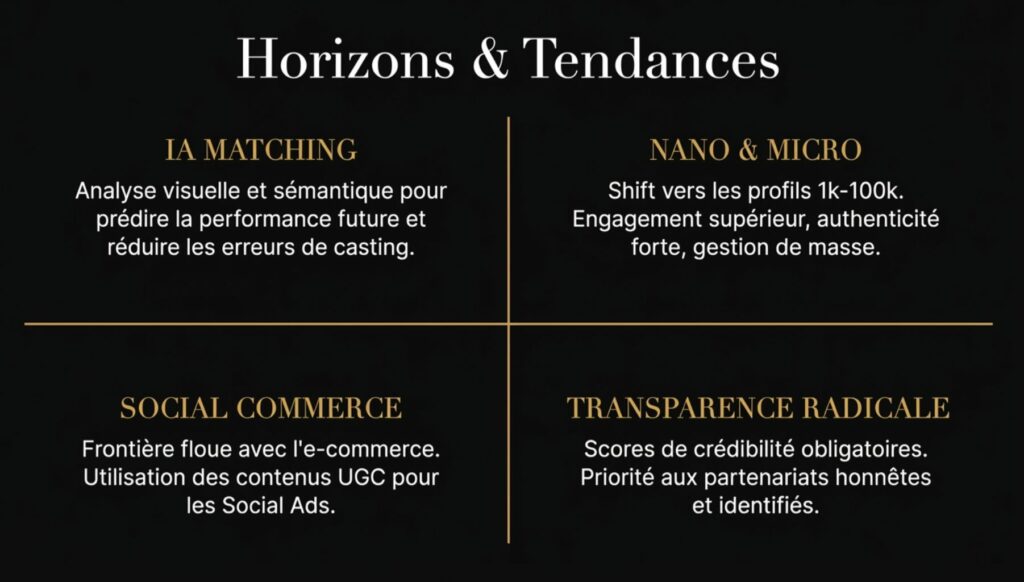
Artificial intelligence for matching brands with influencers
AI is revolutionising matching by going far beyond demographic criteria. Today’s algorithms analyse the visual and semantic content of millions of posts to predict the future performance of a collaboration. This technology delivers phenomenal time savings and improves the relevance of suggestions, drastically reducing the risk of casting errors. Some platforms even anticipate viral trends before they take off.
The rise of nano and micro-influencers
Brands are moving away from the race for millions of followers to focus on nano (1–10k) and micro-influencers (10–100k). Platforms are making it easier to identify them at scale, enabling the management of hundreds of small-scale collaborations simultaneously. These profiles offer higher engagement rates, strong authenticity and a lower entry cost, making it possible to reach highly specific niches with precision.
The integration of UGC and shoppable content
The line between influence and e-commerce is blurring. Platforms now incorporate Social Commerce features: product tags, integrated storefronts and direct purchase links. At the same time, they are evolving into UGC (User Generated Content) engines, enabling brands to legally repurpose creators’ videos and photos in their own advertising campaigns (Social Ads), thereby significantly increasing conversion rates.
Transparency and authenticity as top priorities
In response to savvy consumers and watchful regulators, platforms are strengthening their compliance tools. Credibility and transparency scores are becoming the norm. Brands now favour tools that can guarantee honest, clearly disclosed and straightforward partnerships, since a company’s reputation is directly shaped by its choice of brand ambassadors.